

WARC Media releases The Future of Commerce Media 2026 examining the intersection of commerce and advertising
August 2026 – The global retail media market continues to grow and evolve, with ad investment projected to surpass $200bn this year and reach $223bn by 2027, per WARC Media. However, growth is slowing towards single digits, and there are dangers of ‘enshittifying’ the shopper experience, which in turn may have a negative impact on campaign effectiveness, as retail media networks look to meet ambitious targets.
Alex Brownsell, Head of Content, WARC Media, says: “The retail media landscape is maturing and
consolidating, forcing marketers to rethink their approach. While retail media excels at converting existing demand, it underperforms on long-term brand building. Retailers face a delicate balancing act: growing ad revenue to boost margins without overwhelming shoppers with too many ad interruptions that compromise both shopper experience and campaign effectiveness. Success now depends on smart integration with other channels and finding the optimal path to sustainable results.”
The Future of Commerce Media 2026 examines key trends and analyses fresh research about the intersection of commerce and advertising.
Global retail media ad market to reach $200.4bn in 2026 and $223.4bn in 2027, but growth slows
On course to reach $200.4bn in 2026, worldwide retail media investment is forecast to grow by 11.5% year-on-year in 2027 to $223.4bn, according to WARC Media’s latest forecasts. By then, retail media will account for 15.2% of total worldwide ad investment.
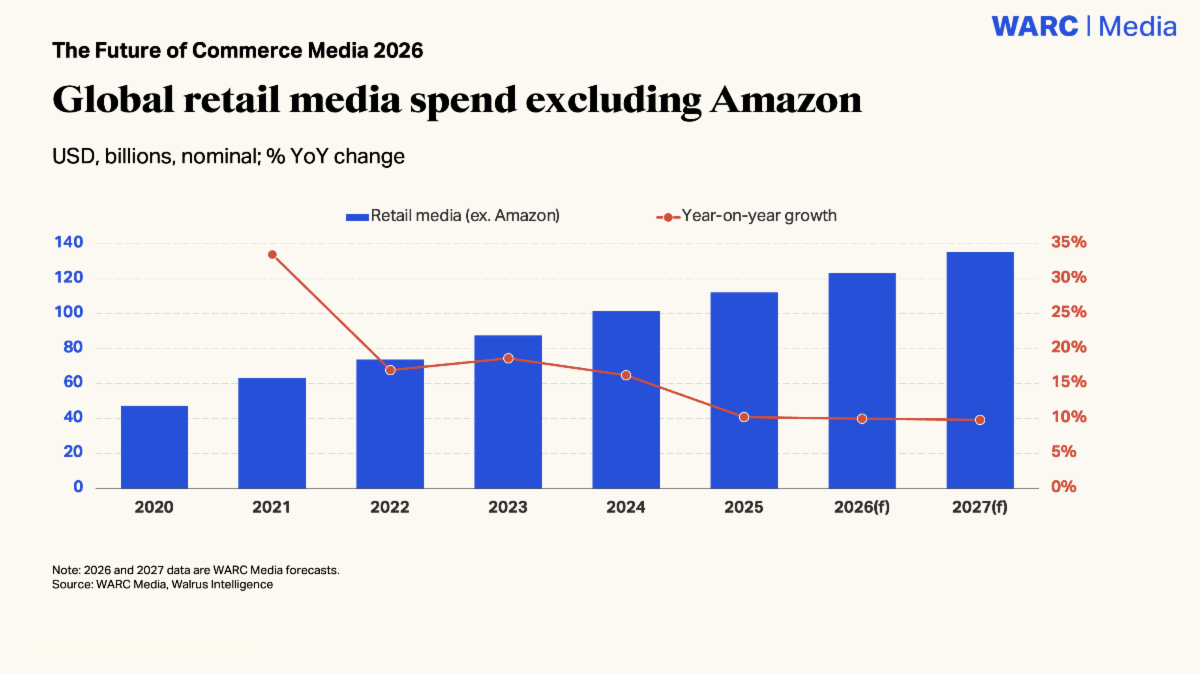
However, growth is slowing towards single digits. When excluding industry leader Amazon, the global retail media market is set to dip to 9.8% in 2027 – the lowest year-on-year rate of growth since WARC Media began monitoring spend.
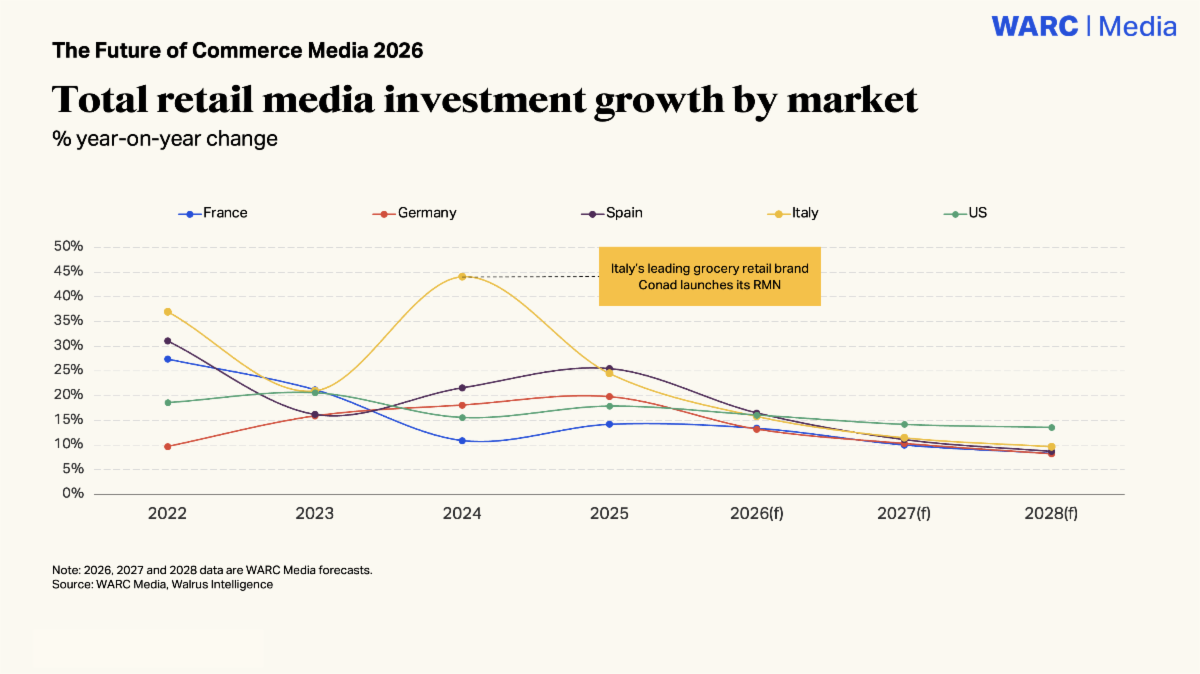
US retail media remains resilient as European growth slows
While European retail media spend growth decelerates to single digits, the US market shows stronger momentum. WARC Media forecasts US retail media network spending will grow 13.6% in 2028 to reach $74.9bn.
But concentration of ad spend remains a challenge. In 2025, Amazon captured 78.0% of all US retail media expenditure, with Walmart taking 7.5%, leaving just 14.5% for all other networks combined, according to Walrus Intelligence. In Europe, more than two-thirds of overall retail media spend went to Amazon in France, Germany, Italy, Spain, and the UK.
Retail media takes more than half of CPG ad budgets
Retail media dominates endemic CPG category budgets. In 2027, retail media will account for 55.8% of all media investment by alcoholic drinks brands globally, and 54.9% of the overall food category spend. However, in fast-growing categories like technology and electronics, retail media is set to only take 15.0% of total spend in 2027 – down from 16.2% in 2025.
Many retail media networks are over-reliant on a small number of core advertisers. Nearly three-quarters (73.9%) of UK brands spend with three or fewer RMNs. WARC Media’s analysis found that among eight of the UK’s largest domestic RMNs, none achieves a third of revenue from the long tail – i.e. the bottom 50% of brands by spend.
Amazon’s non-retail advertising business – spanning Prime Video and Twitch – is projected to generate $6.7bn in 2027, surpassing Walmart’s total 2025 ad spend. As a standalone entity, it would be the world’s second-largest commerce media operation outside China, highlighting Amazon’s expanding dominance beyond traditional retail media.
Retail media can help bring SMEs into the TV ad market
Video on-demand is poised to overtake retail media’s global advertising investment by 2028, according to WARC Media forecasts, with connected TV already representing 23% of retail media spend.
Walmart’s acquisition of Vibe.co points towards a clear growth opportunity for retail media networks, by encouraging smaller brands, which until now focused on performance, to begin exploring channels like CTV.
‘Enshittification’ a risk as retail media networks try to meet ambitious targets
As commerce media enters a phase of slower growth and consolidation, it risks what tech author Cory Doctorow has called “enshittification”, where the digital experience declines as platforms look to fuel monetisation at the expense of users and business customers.
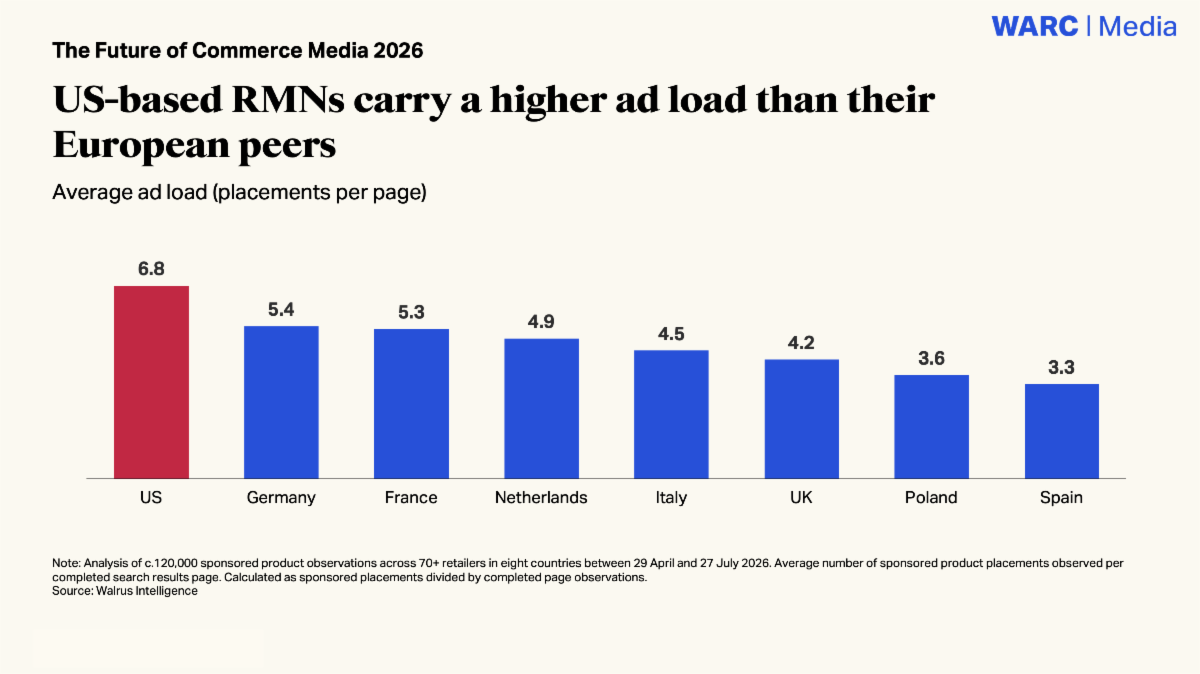
With consumer spending under pressure, it may be tempting for RMNs to dial up ad loads. Amazon, The Home Depot, Macy’s and Walmart each serves 20+ ads per page on average, research has found.
To avoid commerce media ‘enshittification’, brands are advised to build a frictionless on-platform experience that prioritises serving users, maximises ad relevance and minimises irrelevant ad clutter. Standardised measurement and arming AI tools with robust datasets and deep consumer understanding can also help.
Retail media creative must work harder than other channels
Retail media creative must work significantly harder just to register with audiences. A study of simulated shopping experiences on Walmart and Amazon by Ipsos found that memory encoding drops by 47% for ads run on retailer platforms, as opposed to those appearing on generic offsite environments.
For undecided shoppers, high creative quality drives a 12% lift in short-term brand choice. For those not in the market, superior creative quality produces a 21% performance advantage over low-quality ads.
More than half (62%) of US grocery buyers claim to have purchased a product directly after seeing it on an in-store screen, yet in-store remains one of the most underdeveloped creative opportunities in retail media.
Additionally, WARC research suggests that retail media ads are good at converting existing demand, but bad at generating long-term outcomes. Brand-side organisational dysfunction and a poor understanding of the contextual requirements of commerce ad formats has led to creative shortcomings the industry must overcome to ensure the effectiveness of retail media campaigns.
Retail media’s most creative potential may exist in the space where channels meet – for instance, through partnerships with creators, and campaigns that span physical and digital touchpoints.
The Future of Commerce Media 2026 is based on data and insights from WARC and external research. WARC members can read the full report.