- 67% of travellers expect brands to personalise their recommendations
- 50% of travellers cannot recall the last tourism ad they saw
- 39% of people say they expect to travel more in the next 12 months than they did in 2025
- 33% of consumers say social media is the leading source for holiday discovery
New LIONS Advisory x TOURISE research Ideas that travel – How tourism brands win the race for tomorrow’s customers presents the IDEAS framework for brand success
October 2026 – The global travel and tourism industry, which accounts for 9% of GDP and supports over 366 million jobs worldwide, stands at a critical crossroads. As demand rebounds and the industry evolves, brands face an unprecedented challenge: how to adapt to a new generation of sophisticated travellers wanting hyper-personalised experiences, authentic storytelling, and frictionless digital journeys.
‘Ideas that travel – How tourism brands win the race for tomorrow’s customers’ is a new study by LIONS Advisory in collaboration with TOURISE, examining the current state of marketing and creative communications in the tourism industry. It unveils the strategies that successful tourism brands are deploying to stay ahead in a competitive marketplace where technology, trust, and transformation are reshaping every aspect of the customer journey, and presents a new practical playbook to drive the sector’s growth.
Paul Coxhill, Chief Operating Officer and President, LIONS, says: “Creativity is a commercial advantage — numerous empirical studies evidence creativity’s role in business growth. The tourism sector is fertile ground for creative effectiveness. Few categories deal so directly in emotion, experience, and memory. Yet in recent years, the sector has seen massive shifts in how people discover, book, and engage with destinations. While demand is rising, so is competition and complexity. This study is designed to make sense of the changing landscape.”
His Excellency Ahmed Al Khateeb, Minister of Tourism of the Kingdom of Saudi Arabia and Chairman of TOURISE, says: “The future of tourism will be shaped through collaboration across industries and disciplines. The destinations that succeed will be those that build meaningful, trusted, and memorable experiences that endure long after the journey ends. In this environment, creativity becomes far more than a communications tool; it is a strategic driver of differentiation, competitiveness, and long-term value. The IDEAS framework offers a valuable lens through which destinations and brands can respond.”
Key takeaways outlined in the Ideas that travel report are:
The five forces reshaping travel & tourism marketing
Travel intent and spend are rising globally, especially among younger travellers and emerging markets. The research found that 39% of respondents plan to travel more in 2026, rising to 51% for Gen Z and 47% for Millennials. Leading growth markets are Brazil, South Africa and India; and almost half of global travellers expect to increase their spending.
Seeking experiences that feel unique, nearly three in four (72%) respondents expect brands to recommend experiences based on their interests, and 71% are considering visiting an emerging destination in the coming year.
Travel discovery is driven by story-led, perspective-driven content. Social media is now the leading source of discovery for holiday planning, cited by 33% of respondents, particularly among young travellers.
More than half (55%) of travellers struggle to identify trustworthy information when travel planning, leading them to use multiple sources such as reviews, creators, friends and family, AI tools and official channels before committing to travel decisions.
Consumers expect journeys to feel personalised, intuitive and connected, cited by 67% of survey respondents; while 62% say they are likely to use AI more often over the next 12 months for research to booking processes.
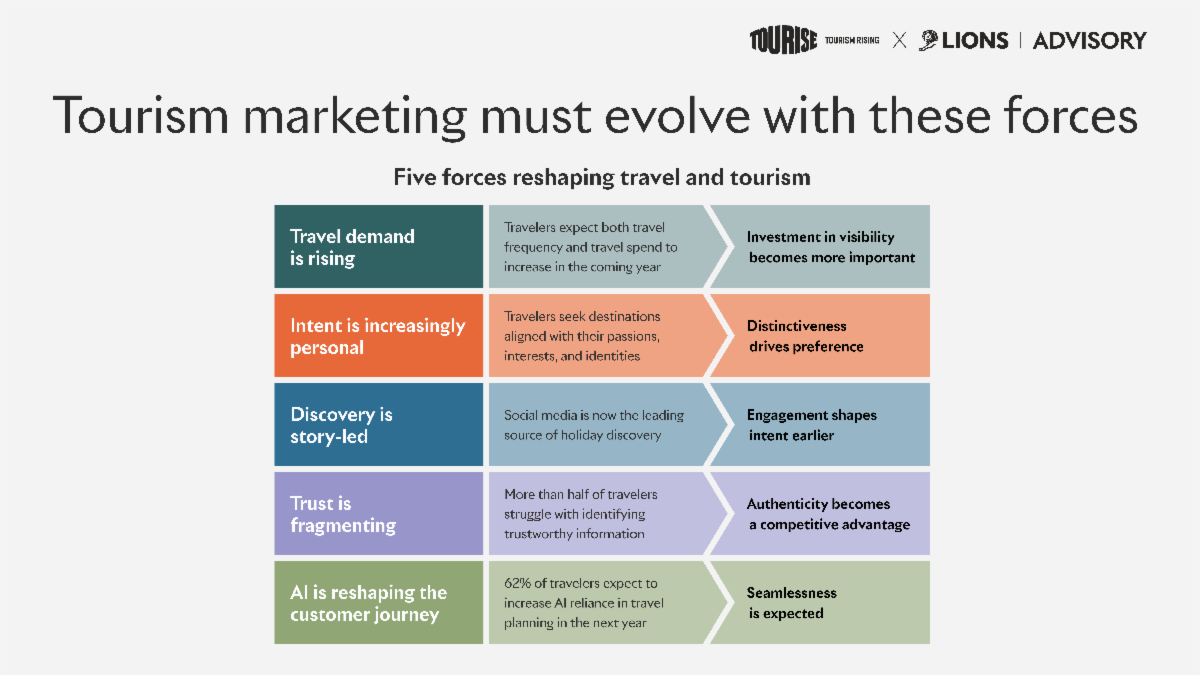
The next era of tourism growth will belong to brands that read these signals early and adapt to meet evolving consumer needs.
IDEAS that travel: a new playbook for growth
Travel demand is soaring offering brands opportunities for growth, but tourism marketing isn’t keeping up. The research found that 60% of travellers agree that many travel ads look similar, while half (50%) cannot recall the last tourism ad they saw. Brands that win will be those that stand out, build trust, and deliver seamless experiences at every stage of the customer journey.
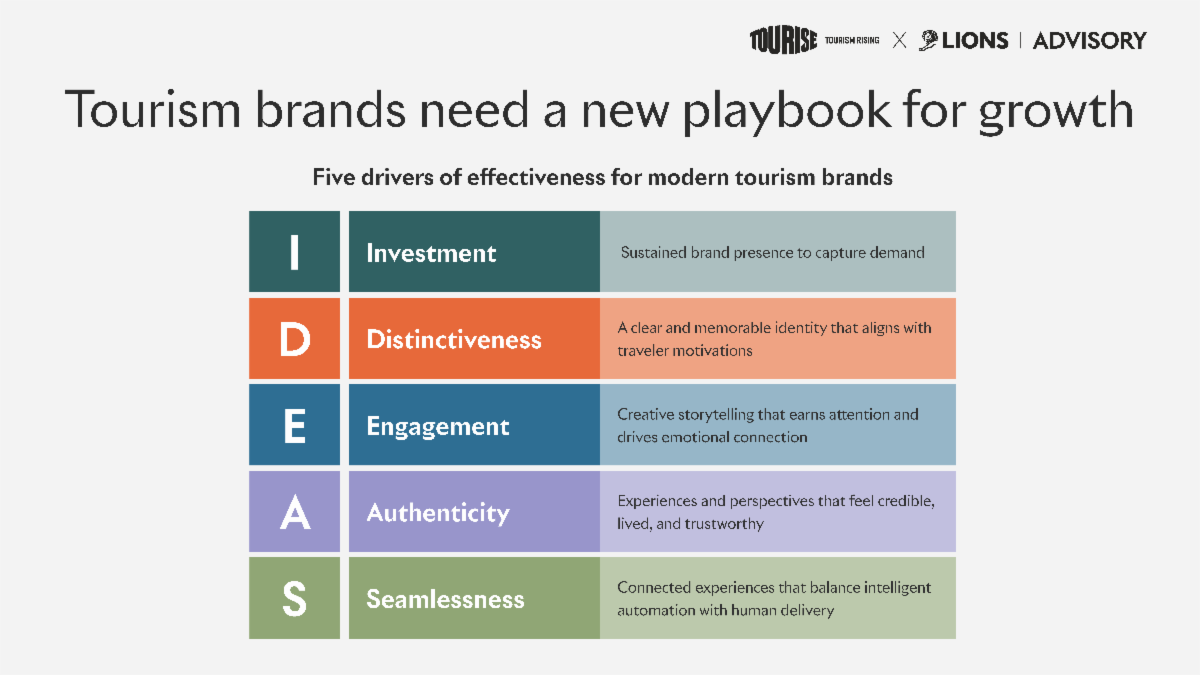
The IDEAS framework offers a practical roadmap for navigating the evolving travel marketing landscape.
- Investment: Post COVID-19 pandemic, global media investment has rebounded to $32.4bn in 2025 but share of voice remains below pre-pandemic levels. According to WARC Media, tourism ad spend under-indexes in social, creator, video and entertainment-led environments. Brands must maintain visibility to strengthen future preference and capture demand.
- Distinctiveness: As travellers seek destinations that reflect their interests, values and identities, broad positioning becomes less effective. Brands are advised to build stronger messaging to achieve a clear and memorable identity that cuts through a crowded sector.
- Engagement: In a media environment shaped by creators, entertainment and algorithmic feeds, tourism brands are competing with more content than ever for attention and interest. Future travellers expect richer storytelling and unexpected creative approaches through emotion, authenticity and cultural resonance.
- Authenticity: Despite being an experience-driven category, tourism marketing hasn’t capitalised on experience as a competitive advantage. Destination perception is shaped as much by reviews, creator content and lived experiences as by official brand communications. Brands are advised to align promise with experience, influence reputation beyond owned channels and treat trust as a growth driver.
- Seamlessness: As AI assistants become more embedded into search, planning and booking journeys, tourism brands will need to influence two audiences simultaneously: travellers and the technology they use. Brands are advised to embrace the principles of brand-building to drive LLM recommendations, use data and automation to create customer value and balance intelligent automation with human delivery.
The report, which also showcases travel and tourism brands that are successfully applying the principles of modern marketing effectiveness, including Airbnb, Visit Sweden and Southwest Airlines, is available to read in full here.