
From disruption to opportunity: WARC’s Marketer’s Toolkit 2027 unveils five trends set to reshape global marketing in the year ahead
Based on WARC’s proprietary GEISTE methodology, insights from 1,000+ marketers worldwide and one-to-one interviews with marketing leaders
10 November 2026 – WARC today presents The Marketer’s Toolkit 2027, revealing five trends set to disrupt global marketing practices in the year ahead, and offers insights to help turn these disruptive areas into opportunities for growth.
Marketer optimism has dipped for the third year in a row, with just 46% expecting business to improve in 2027, according to WARC research. While that is a drop of nearly 20pp from three years ago, fewer marketers anticipate budget cuts. And even though WARC Media forecasts global ad spend growth will slow to 8.4%, reaching $1.46tn in 2027, emerging shifts could offer new opportunities, from important AI and social media evolutions to changing summer behaviours and the rise of the clip economy.
Aditya Kishore, Insight Director, WARC, says: “The macroeconomic backdrop remains challenging – a fading middle market, mounting sovereign debt, and a cost-of-living crisis are all still weighing on marketer optimism. But beneath these pressures, important shifts are reshaping the industry. AI agents are starting to influence how consumers shop, algorithms are superseding social connections on social media, and the rise of the clip economy is changing how brands connect with audiences. Marketers who understand these emerging trends – and act on them – have a genuine opportunity to turn disruption into growth in 2027.”
The trend identification for the report, now in its 16th year, is based on WARC’s proprietary GEISTE framework, which focuses on the broad macro trends across government, economy, industry, society, technology, and environment. It further incorporates a global survey of 1,000 marketing executives conducted in September and October 2026, one-to-one interviews with leading marketers worldwide, and analysis and insight from WARC’s global team of experts.
The five trends outlined in WARC’s Marketer’s Toolkit 2027 that will shape marketing strategies next year are:
The drive to AI delegation:
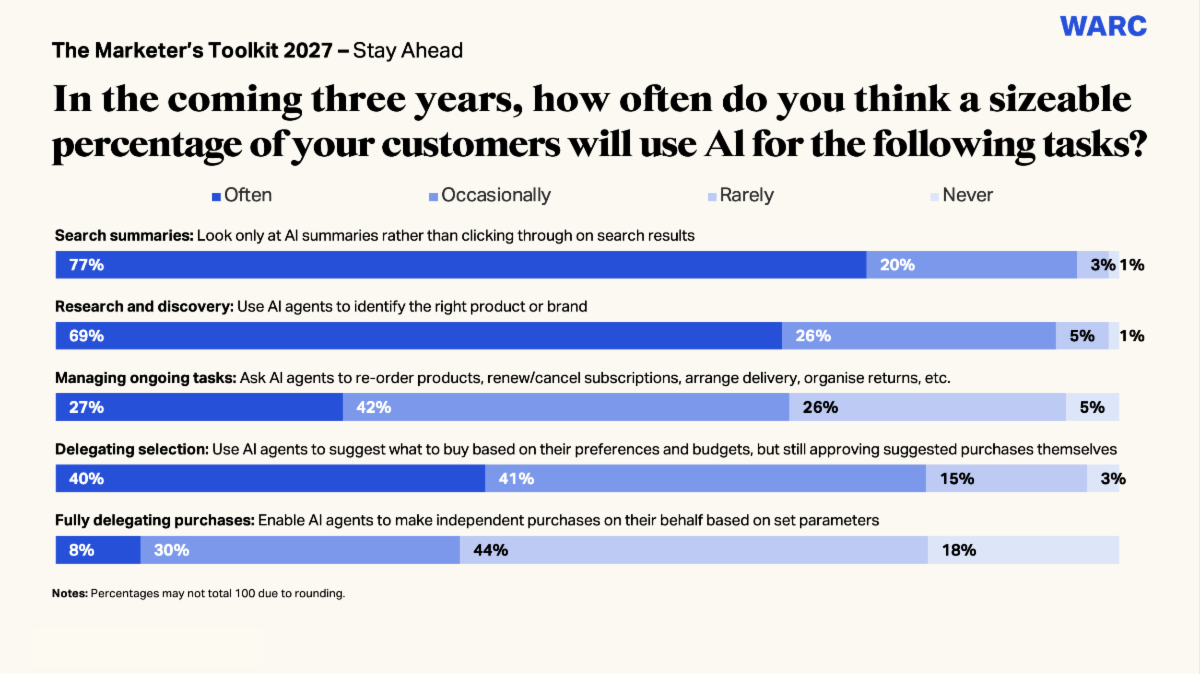
Seven out of ten (69%) marketers expect customers to use AI agents for product research in the next three years, but just 8% expect full purchase delegation to AI.
PHD and WARC predict “agent-facilitated” consumer spending could reach $944 billion in 2026 and $3.4 trillion in 2030. As AI tools grow in sophistication, consumers will increasingly delegate everyday tasks, including purchases, to agentic assistants. This “delegation economy” is valuable, complex and requires holistic brand building, not just a relentless focus on AI optimisation.
Marketers are advised to: (1) build brands with people and AI in mind. (2) Assess how quickly AI delegation will reshape their individual category. (3) Break down internal silos to enable holistic thinking.
The post-social era:
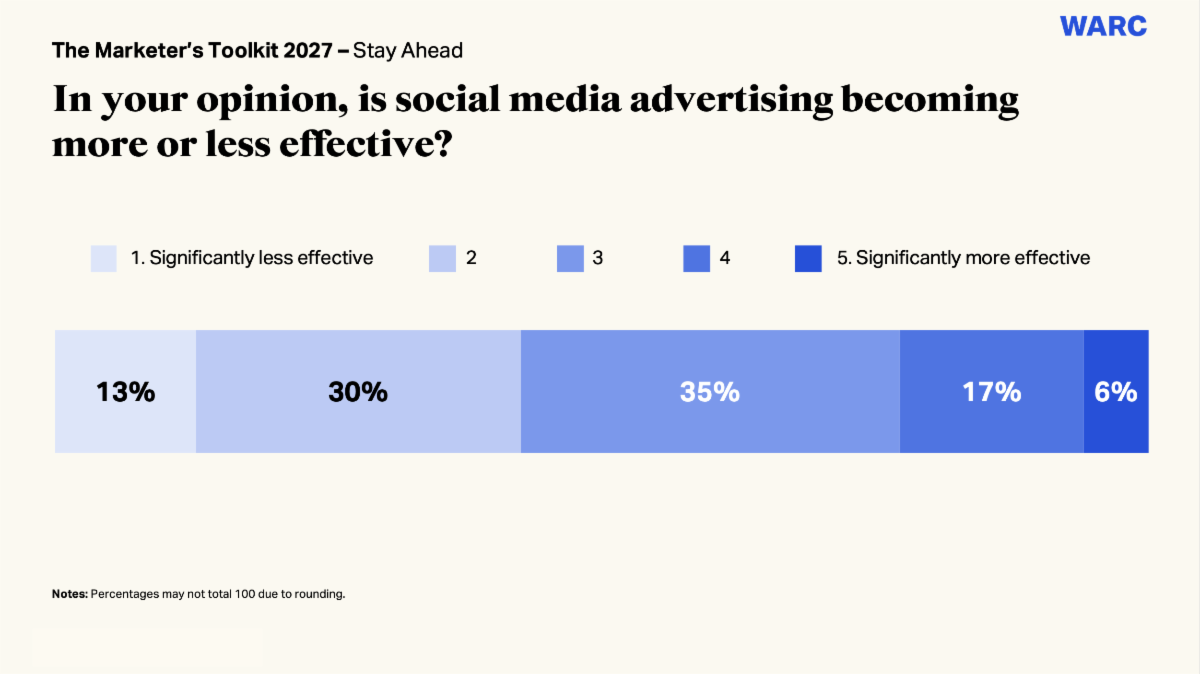
Two in five (43%) advertisers believe social media advertising is becoming “less effective”, but nearly six in ten (58%) feel ad buying practices are “too set” to cut platforms from media plans, even if traffic declines.
Social ad investment is set to hit $394.6bn globally this year – up 21.3% on 2025, per WARC Media, the fastest growth across all channels, even as we enter a post-social era.
Platforms no longer drive social connections. Instead, the algorithm is king, with audiences immersed in highly personalised, interest-based, and constantly refreshed content feeds. This impacts how brands plan, buy and measure campaigns in social media.
Marc Pritchard, Chief Brand Officer, Procter & Gamble, said: “You need to make sure that you create memory in the algorithm. What we’ve learned is that you need a much higher volume of content, a much higher variety of content, at a much higher velocity.”
Marketers are advised to: (1) Recognise algorithms penalise brands that don’t provide fresh creative. (2) Focus on resonance – distinct audience drivers such as motivations and pain-points – rather than volume for creative diversification. (3) Understand the broad range of reasons a consumer might buy your product. Audience insights will be key to post-social marketing.
The clip economy
Four in five (83%) marketers say short-form videos are a popular format among consumers, yet two in five (40%) doubt it can deliver the same brand halo as TV, film, and events.
Content is atomising into ever-smaller units, and the clip – not the original work it came from, but built to flood feeds, game the algorithm, and compound through network effects – has become where attention, discovery and engagement now concentrates. As distribution decentralises to fans, creators and algorithms, brands must rethink how content is packaged and released for a clip economy.
Marketers are advised to: (1) build distribution into the creative brief, deciding upfront what to hold back as a hero moment. (2) Brief creators as strategic partners, not just producers. (3) Plan content as a coherent, connected series, so each clip builds on the last.
David Sandström, CMO, Klarna, says: “I think that advertising has slowly regained its mojo due to clipping. I feel that advertising was paid for and pushed down people’s throats. It didn’t really understand how people really wanted to consume content. But now with clipping […] it feels like advertising is back a bit.”
The summer wildcard
Nearly half (45%) of marketers have not seriously considered how rising summer temperatures could affect their category, while only one in four (25%) have taken action.
Climate change is making summer a less predictable consumer season. Extreme weather is reshaping when, where and how people spend – disrupting established marketing occasions while creating new demands. Bloomberg reports that this summer’s heat resulted in a €17 billion hit to European GDP. Marketers may need to rethink seasonal assumptions, build flexibility, and identify opportunities for adaptation.
James Thornton, CEO, Intrepid Travel, said: “Climate change’s impact on travel isn’t going unnoticed by travellers […] For example, we’ve seen strong growth in demand into the cooler shoulder seasons, particularly in Europe in recent years. When customers do travel within the summer months, there has been notable rising demand for cooler destinations, including Iceland and Norway.”
Marketers are advised to: (1) understand how extreme weather affects their category across search, sales, rising prices and supply-chain disruption. (2) Build flexibility into marketing plans, preparing for disruption without losing sight of long-term brand building. (3) Find growth opportunities in climate adaptation.
The AI tightrope
Marketers are split on AI: four in ten (42%) expect it to boost marketing effectiveness, but just as many remain unsure, and one in five (19%) have negative expectations.
AI offers marketers the promise of near-limitless scalability and individual-level personalisation with advertising creatives, but consumers strongly mistrust AI. As marketers look to harness the power of AI, they will need to find the right balance between consumer concerns and best practices for AI utilisation.
Selina Sykes, Global VP Digital, Social and AI Transformation, Unilever, says: “You can’t just take the way you worked without AI and replace it with AI. You need to reimagine the workflow […] you need to think about the outcomes – and then work backwards to the process, inputs and where it starts to touch other parts of the marketing ecosystem.”
Marketers are advised to: (1) Strike the right balance between transparency and efficacy in communicating AI utilisation. (2) Find consumers’ acceptance threshold for AI-generated ads, which could vary by category. (3) Keep humans at the core – build campaigns with human ideation and judgement, while using AI to expand and adapt.